


Real estate agents get paid a commission, or a percentage of the home's final sale price, at the close of a sale. Since agents don't receive a fixed salary, they only earn money if the property sells.
Real estate commission averages 2.76% nationwide for listing agents and 2.70% for buyer's agents. Sellers typically pay both commission fees, but buyers are responsible for their agent's fee if the seller decides not to cover it.
It's possible to negotiate realtor fees or shop around for competitive rates. Some agents provide full service for much less than the traditional commission.
Want to save on real estate agent commission? We can connect you with top local agents from leading brokerages like RE/MAX and Keller Williams. Agents you find through us provide traditional full service for a 1.5% listing fee — a rate we’ve already negotiated for you. This lower fee saves sellers an average of $7,000. Answer 5 short questions to get matched with the top 1.5% agents near you.
How does a real estate agent get paid?
Realtors earn their commission at the close of a home sale following these three steps:
- Closing process. At the home sale's closing, the title company, escrow service, or attorney finalizes the closing statements and issues commission checks to each agent's brokerage.
- Brokerage payment. These commissions get paid first to the agents' brokerages. The brokerage then divides the commission and gives part to the agent.
- Commission distribution. After deducting any applicable fees, the remaining commission gets paid to the agents via check or direct ACH deposit into their bank accounts.
Other ways an agent can get paid
Besides the traditional commission structure, there are alternative models through which realtors earn their income:
Desk rent model: Some agents pay their brokerage a fixed "desk rent" rather than a split commission. This arrangement allows them to keep 100% of the commission from each sale while still affiliating with a brokerage that oversees their professional conduct.
Salaried agents: Certain brokerages offer their agents a base salary complemented by bonuses for each home sold. This model involves a smaller commission on sales but provides agents with a steady income, mitigating the unpredictability of commission-based earnings.
Do real estate agents get paid if the house doesn't sell?
Agents typically don't earn money if a home doesn't sell because they work on a commission basis, without a salary from their brokerage.
A standard listing agreement or buyer's agency agreement outlines a specific period for the home sale. The agent usually doesn't receive payment if the sale doesn't occur within this timeframe. The home seller or buyer is also free to sign with another brokerage.
However, there are rare exceptions where a client might owe a fee, such as if a buyer withdraws from a signed agreement of sale, or if a seller's failure to disclose significant defects leads to a sale falling through.
How much do real estate agents get paid?
Real estate agent commission on a home sale averages 5.46% nationwide, with the seller's agent receiving 2.76% and the buyer's agent 2.70%.
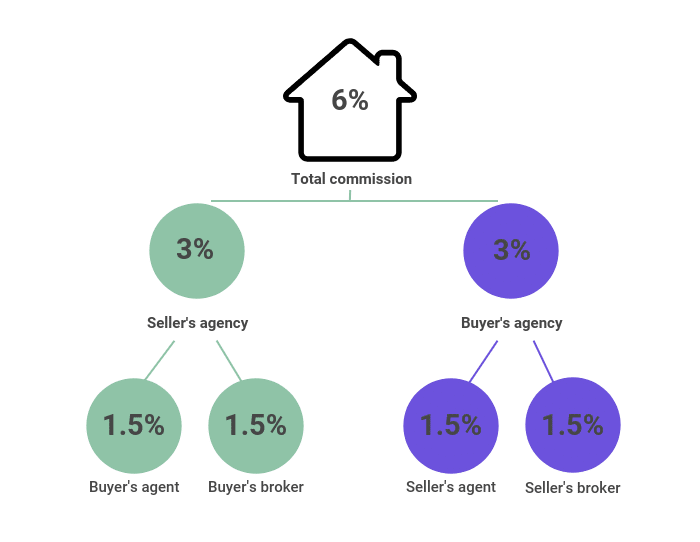
Here's what that could look like on a $400,000 home sale, with each agent earning 3%.
| Commission rate | Dollar amount | |
|---|---|---|
| Listing agent | 3% | $12,000 |
| Buyer's agent | 3% | $12,000 |
| Total | 6% | $24,000 |
However, the agents don't walk away with $12,000 each. They have to split their commissions with their brokerages, and they may owe additional fees.
How do commission splits work?
Commission splits between realtors and their brokerages are a significant part of a realtor's expenses.
The split varies based on the agent's experience and negotiation with their brokerage. For example, newer agents might see a 30/70 split, with the agent keeping 30% and the brokerage getting 70%. Seasoned agents could keep 80–90% of their commission, sometimes nearing the full 100%.
Here's an example of a 50/50 split:
So, if a seller's agent earns a $12,000 commission from a $400,000 sale, a 50/50 agreement with their brokerage means the agent would take home $6,000.
Beyond this split, realtors face other regular expenses, contributing to their overall cost of doing business. These expenses can include MLS dues, marketing and advertising costs, professional licensing and association fees, office or desk fees, continuing education, and insurance.
Why do sellers pay the buyer's agent commission?
Sellers often cover the buyer’s realtor fee to make their homes more attractive and to help buyers afford the purchase.
Agent commissions are typically factored into the listing price and paid out of the sale proceeds, meaning sellers don’t pay out of pocket and buyers effectively finance the cost through their mortgage.
For decades, the National Association of Realtors (NAR) required sellers listing on NAR-affiliated MLS platforms to offer compensation to buyer’s agents. Sellers set the commission rate and advertised it in MLS listings, which motivated agents to show those homes. Since more than 88% of homes sell through the MLS,[1] this practice became the industry standard.
That changed in 2024, when NAR settled a lawsuit over inflated commissions.[2] Sellers can no longer advertise buyer’s agent fees in MLS listings. Instead, buyers must negotiate their agent’s fee directly, though buyers and sellers can still agree for the seller to cover that cost via a seller credit at closing.
Even without the obligation, many sellers continue paying buyer’s agent commissions because it helps attract more buyers and increases the chances of a successful sale.
Can sellers refuse to pay the buyer's agent?
Yes, sellers can refuse to pay the buyer's agent. However, not doing so may drive buyers away and make the home harder to sell.
Since the buyer and their agent agreed on a specific commission rate in their contract, buyers are ultimately responsible for paying the fee and must cover whatever the seller doesn't.
It’s smart for buyers to budget for their agent’s commission in advance. If the seller won’t cover it, buyers may need to pay their agent directly with cash at closing.
Can you save on realtor commissions?
Exploring more cost-effective alternatives to a traditional realtor can lead to big savings. Here are the most common ways sellers reduce commission costs:
- Negotiate realtor fees (not always successful): Some sellers try to negotiate a lower commission directly with their agent. While this can reduce costs without sacrificing professional support, it’s not common — only about 2 in 10 sellers manage to secure a lower rate.[1] Negotiation works best when you're in a competitive market or your home is especially desirable.
- Sell without a realtor (a lot of work, not recommended): Selling without a listing agent avoids the listing commission. But the process is time-consuming: you’ll be responsible for pricing, marketing, showings, paperwork, and more. And it often leads to a lower sale price ($55,000 less on average).[1] Also, you may not avoid commission entirely if you pay for the buyer's agent. If you sell this way, we recommend using a flat fee MLS service to boost your listing's visibility for a few hundred dollars.
- Use a low-commission agent (best option for most sellers): Partnering with a low-commission agent can give you the same full service as a traditional realtor, but at a fraction of the cost. Many work for 1.5–2% listing fees, saving you thousands without sacrificing support or market exposure. The key is choosing a reputable low-commission agent who offers full service instead of limited assistance.
Working with a low-commission agent is often the smartest path for sellers who want big savings without the stress of FSBO or the uphill battle of negotiating fees. You’ll keep more of your profit while still getting expert guidance, MLS exposure, and professional marketing.
FAQ about how real estate agents get paid
Who pays for real estate agents?
Traditionally, sellers paid for both their own agent (the listing agent) and the buyer’s agent. After the 2024 NAR settlement, sellers are no longer required to offer buyer’s agent compensation in MLS listings. Instead, buyers and their agents negotiate the buyer’s fee directly, though sellers may still agree to cover it as a concession to attract buyers. Learn more about who pays realtor fees.
How does commission work?
Real estate commissions are typically 5–6% of the home’s sale price, averaging 5.46% nationwide. This total is split between the listing agent and the buyer’s agent, with each agent then splitting their share with their brokerage. Buyers and sellers can negotiate who covers the buyer’s agent fee at closing.
How much do real estate agents get paid?
Agents earn a percentage of the home sale price each time they close a transaction. For example, on a $500,000 home with a 3% listing fee, the listing agent would earn $15,000. The agent would then split that commission with their broker. With a 70/30 split, the agent would take home $10,500. Learn more about how much real estate agents make.
How often do real estate agents get paid?
Agents only get paid when a sale closes. They don’t earn a salary — commissions are their primary source of income. So if an agent sells six homes in a year, they would get paid six times that year.
How much do real estate agents get paid a year?
The median annual wage for real estate agents was $58,960 in 2024.[3] Income varies widely depending on the market, experience level, and number of transactions closed.
Related reading